04 February 2026
What happens when Europe’s public safety responders need to work together — across borders, terrains, and technologies?
The answer is EUCCS – the European Critical Communication System.
Identified as a key priority in the European Commission Work Programme 2026, EUCCS aims to progressively deliver a secure, resilient, and fully interoperable critical communication capability for public safety and emergency services.
The first operational EUCCS system is targeted for 2030, with the ambition to eventually cover all EU and Schengen-associated states.
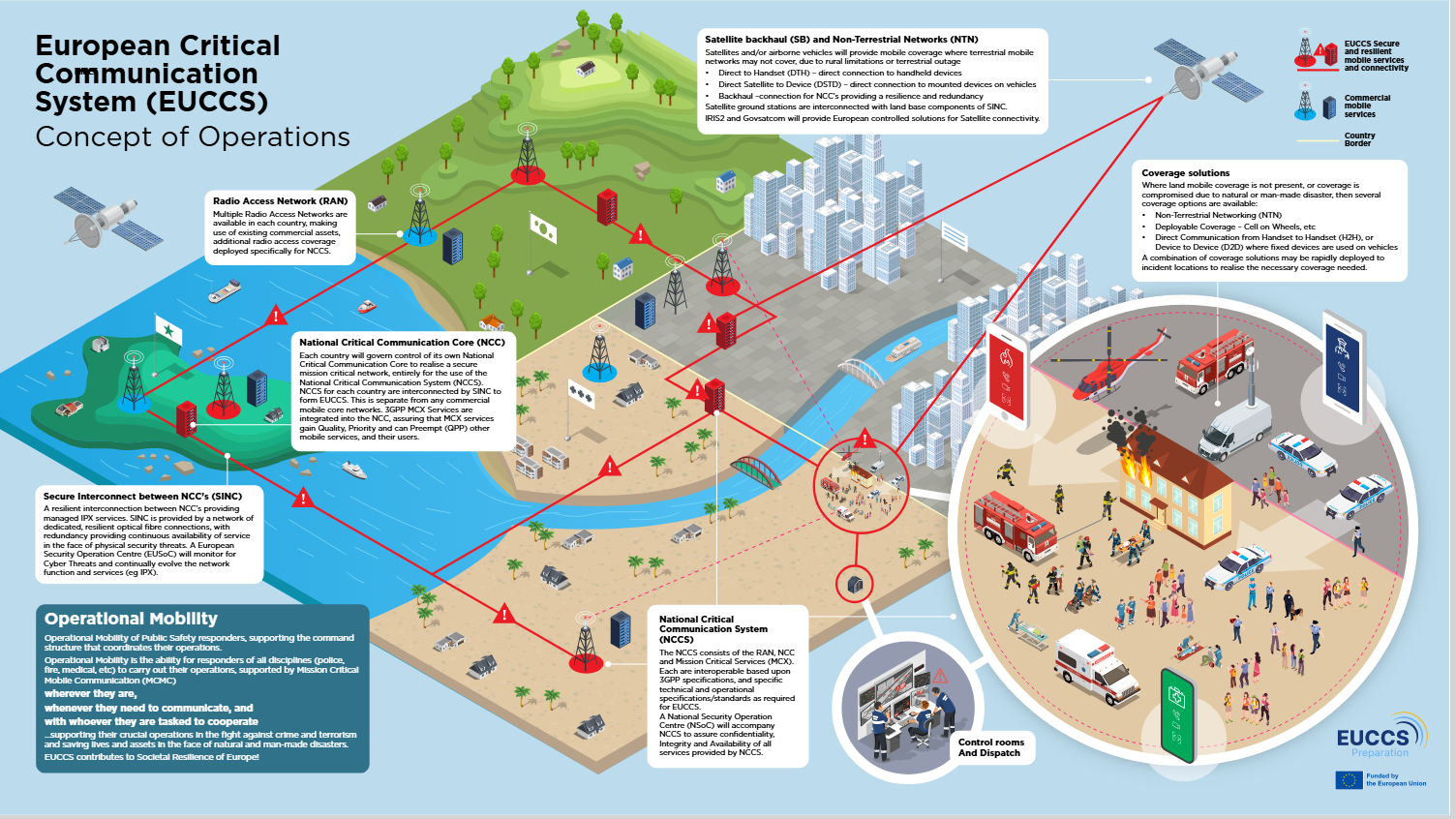
EUCCS is built on a federated model. Each participating country will operate its own National Critical Communication System (NCCS), while remaining fully interoperable at the European level.
Each NCCS will be based on 3GPP standards and will combine:
This approach allows countries to retain national sovereignty over their systems while ensuring seamless cooperation across borders.
Operational mobility is at the heart of EUCCS.
As illustrated in the system architecture, national NCCS platforms are interconnected through a Secure and Resilient Interconnect (SINC). This interconnection enables public safety responders to:
EUCCS ensures that technology never becomes a barrier when rapid, coordinated action is required.
Through EUCCS, Operational Mobility empowers public safety responders to communicate:
By enabling trusted, cross-border communications at scale, EUCCS strengthens Europe’s collective ability to respond to crises, emergencies, and large-scale incidents, together.
🔎 Find a description of this illustration here: https://doc.psc-europecollab.eu/index.php/s/YEqwRiGisKDYqzG?dir=/&editing=false&openfile=true