26 November 2025
Civitavecchia, Italy, 24/11/2025— Last week, the Port of Civitavecchia hosted a major European exercise and large-scale simulation which aimed towards improving coordination and collaboration between emergency services across Europe. More than 100 participants from across Europe engaged in the activities that revolved around a technology trial and operational procedures assessment, organised as part of the EUCCS Preparation programme, which is preparing towards the establishment of the European Critical Communications System (EUCCS).
The operation was supported by the Italian Ministry of the Interior, Civitavecchia Port Authority, Guardia Costiera, Guardia di Finanza, Carabinieri, Vigili del Fuoco, and the Polizia di Frontiera. We brought together a wide range of actors: 24 operational responders (12 police officers, 5 firefighters, and 7 rescue personnel), 13 maritime and aerial crew members, 19 additional responders from our Operational Procedures Team, 9 National Testbed Management teams, 11 observers, and 14 international VIPs from Norway, Switzerland, Germany, the Netherlands. European Commission DG Home Affairs, and European agencies such as Europol and Frontex.
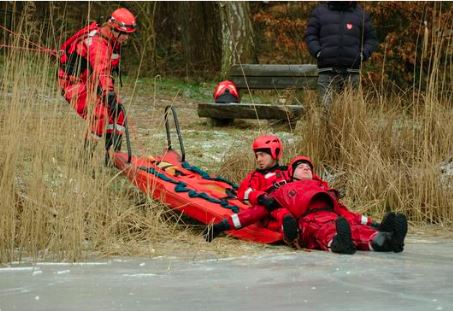
The main scenario recreated a situation commonly faced in the region: intercepting a vessel suspected of migrant smuggling in the Mediterranean. Additional simulated incidents — a road traffic accident, hazardous materials contamination, a complex medical emergency, and cross-border surveillance —enabled players to test how different mission critical mobile broadband technology could support cross-agency and cross-border operational procedures across a variety of real world situations. Three separate control rooms, each playing from a different country, were activated to simulate realistic international coordination.
The goal of EUCCS Preparation Pilot Trials is to test how new Mission Critical mobile broadband communication tools support operational mobility on the ground in real world conditions and scenarios. The foundational communication standards are 3GPP Mission Critical Services, which will allow different European countries to procure and operate their own systems, and interconnect those national systems. The goal is for these systems to be interconnected to allow for Operational Mobility of our responders to support coordinated response to crime fighting and lifesaving operations. Operational Mobility enables responders to use mobile communication, wherever they are, whenever they need to communicate, and with whoever they are tasked to collaborate.
These new tools are capable of transmitting voice, images and operational data in real time between teams across complex real-world response situations, as simulated in this scenario. Crucially, just having the technical functionalities is not enough. It is also important to understand how Standard Operational Procedures will be supported by this technology, how procedures might need to adapt as a result of the new capabilities, and how technology might need to adapt to ensure procedures work. It is also important to know how the European response community will be able to use this technology in practice. Technology must support its use, and not hinder it. Technology should support response efforts, not complicate them. Responders need technology that is built around how people actually work in crisis situations.
Observers assessed how information flowed between agencies, the risks of information overload, the quality of coordination and how robust the systems were when used in real-world conditions where operation of the mobile network coverage and services can be challenging.
The results of this trial will help shape future European operational procedures for cross-border emergency responses and guide improvements to the technologies relied upon by public safety services. It will also help to improve the maturity of the technical solutions, providing valuable feedback to the Contractors. This trial made use of interconnected solutions provided by our coontractors Leonardo and Frequentis, A second large-scale trial, planned for March 2026, will test interconnected solutions of Airbus and Teltronic.
This all brings Europe closer to realizing a unified, secure and resiliant emergency communication system : the European Critical Communication System (EUCCS).