30 September 2026
The European Commission has proposed the creation of an EU Critical Communication System (EUCCS), a new framework to give European first responders secure, resilient and interoperable communications across services and across borders. This is a defining moment for EUCCS Preparation, which has spent many years working with national authorities, responders and industry on the foundations of the system.
A long-standing operational gap
Fires, floods, storms, drone threats to critical infrastructure and terrorist attacks demand a coordinated response from police, firefighters, medical services and civil protection teams. Yet their communication systems are largely not connected to one another, and they can stop working when responders cross a border. Emergency services therefore often cannot talk to each other when they are working to rescue people and restore security.
The EUCCS is meant to close this gap. Responders would be able to communicate across services and borders, and to share photos, video, voice, audio, messages and geolocation in real time through a single secure device, both nationally and throughout Europe.
What the proposal sets out
A shift from narrowband to broadband. Member States would gradually move from narrowband radio systems to broadband technology such as 5G. This opens the way to richer information sharing, and to better situational awareness and coordination during crisis situations.
Connectivity that holds when networks fail. EU satellites would provide back-up where land-based systems are incapacitated, for example during a blackout. Mobile deployable communication units could restore connectivity for emergency coordination where no network is available.
Priority for first responders. The system is designed to stay available and to give priority to responders, even when the mobile network is saturated or disrupted.
Security by design. The system would be protected against cyber and hybrid attacks through encryption and a strong protocol. Two dedicated entities would support it:
European technological sovereignty. The system’s critical components, including satellites, the core mobile networks and the mobile broadband technology, would be developed by European companies. This reduces reliance on foreign technologies. The system would cover the EU and the Schengen Associated Countries, turning critical communication from a regional or national tool into a European one that can serve many more services.
Member States in control. While interconnected at European level, Member States would keep full control over their national networks and over the governance of the system, which would be ensured by a Member States’ expert group. The Commission would also support cooperation with industry and research organisations so that the system keeps pace with innovation.
The road ahead
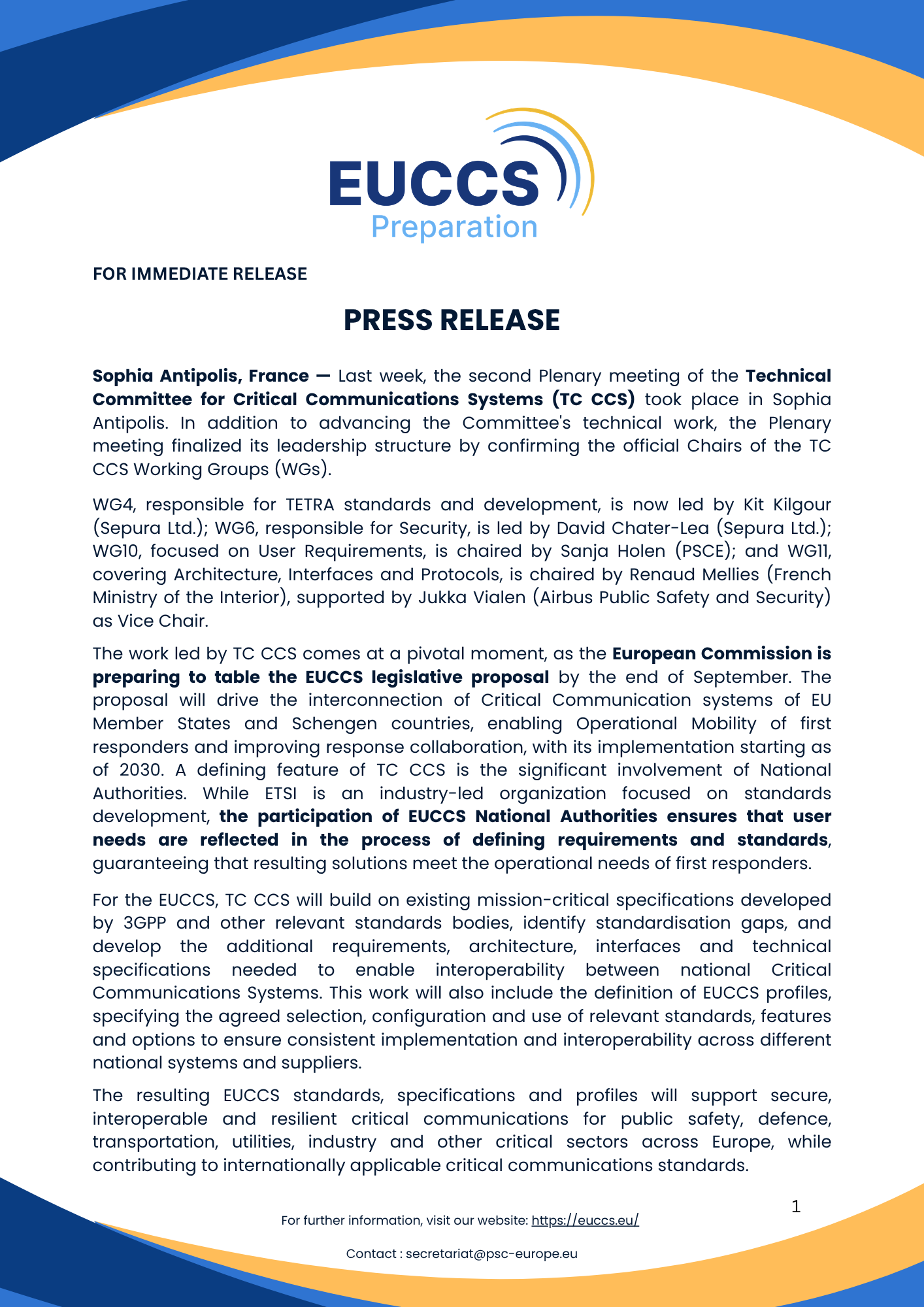
The European Parliament and the Council must now adopt the proposed Regulations. The EUCCS is planned to be launched gradually, with a built-in transition period for Member States, starting in 2030.
The proposal follows on from earlier political commitments. The EUCCS was identified as a key action of the ProtectEU internal security strategy (April 2025) and of the Preparedness Union Strategy (March 2025). It also builds on the recommendations of the Niinistö Report on EU preparedness and readiness, which urged the EU to complete the system as soon as possible, and on a long-standing request from Member States, reflected in the Council conclusions of June 2021, and from first responders themselves.
What this means for practitioners and industry
For practitioners, the proposal offers the prospect of communicating with colleagues from other services and other countries without having to rely on ad hoc solutions. For national authorities, it makes investment in critical communication more attractive, since the reach of the system extends from a national tool to one that covers the whole EU. For industry, it sets out a clear European framework, with European companies building the critical components.
Building the foundations: the role of EUCCS Preparation
The EUCCS Preparation programme supports the establishment of the system, working with experts from most EU Member States and Schengen countries to prepare the technology, the application ecosystem and the procedures for its use. Its work includes:
The programme’s overall goal is Operational Mobility: the ability for responders to carry out their operations wherever they are, whenever they need to, and with anyone in their communication group.
Next steps for EUCCS Preparation
As the proposal moves through the legislative process, EUCCS Preparation will continue its work with Member States, practitioners and industry, and will keep sharing updates on the progress of the system and of its own activities.